
Stone Veneer Siding in Grady County, OK
Professional Stone Veneer Siding in Grady County, OK — Licensed, Insured & Locally Owned
Get professional stone veneer siding in Grady County, OK. Grady County Siding Company serves Chickasha, Blanchard & all surrounding areas. Call (405) 529-1859 today.
Stone veneer siding is a premium exterior cladding solution that replicates the timeless look of natural stone at a fraction of the weight and cost. Unlike full-cut stone, manufactured or natural thin stone veneer panels attach directly to your home’s existing structure, delivering dramatic curb appeal without requiring extensive structural reinforcement.
At Grady County Siding Company, we understand that homes across Grady County face a unique set of environmental pressures — from Oklahoma’s relentless wind corridors and summer heat indexes exceeding 110°F to expansive clay soils that shift with every rain cycle. Our installation approach is specifically calibrated for these conditions, ensuring your stone veneer siding performs beautifully for decades, not just seasons.
Read moreShow less
Whether you’re updating a ranch home in Chickasha, adding character to a new build in Blanchard, or replacing failing siding in Tuttle, our team brings hands-on local expertise to every project. Call us today at (405) 529-1859 to schedule your free on-site evaluation.
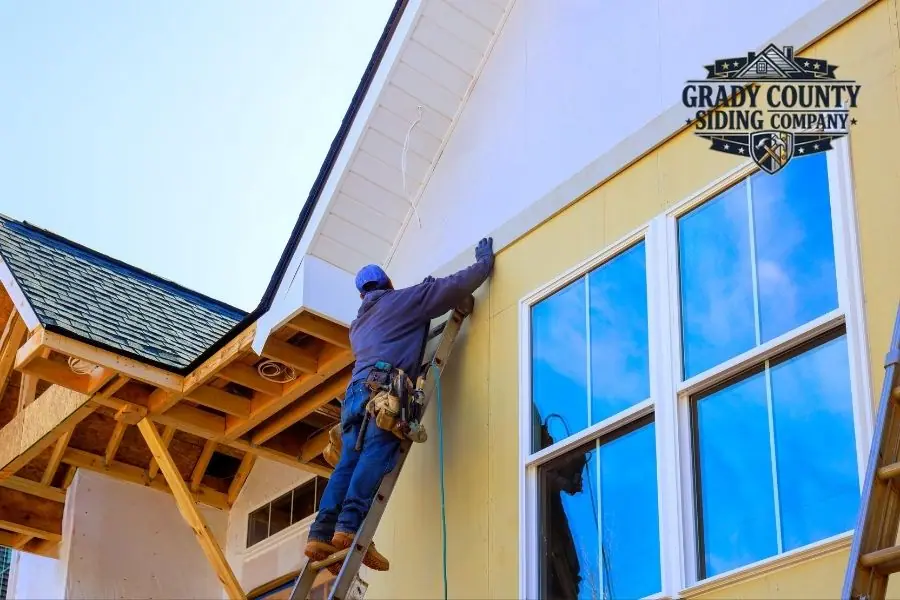
Understanding Stone Veneer Siding
Stone veneer siding refers to a thin layer of either natural or manufactured stone-like material applied to the exterior walls of a structure. The “veneer” designation means the stone is typically between ¾ inch and 1½ inches thick — far lighter than traditional full-bed masonry — and is adhered to a prepared substrate rather than serving a structural purpose. This distinction makes it accessible to virtually any home style without requiring costly foundation or framing upgrades.
There are two primary categories: natural thin stone veneer, which is quarried real stone split or cut to a uniform thinness, and manufactured stone veneer (MSV), which is engineered from Portland cement, aggregates, and iron oxide pigments to mimic the look of fieldstone, limestone, river rock, cobblestone, and dozens of other profiles. Manufactured stone veneer has become particularly prevalent in Oklahoma because its consistent thickness and lighter weight reduce stress on wood-framed structures that must already contend with wind loading from frequent storms.
Read moreShow less
Historically, stone construction in central Oklahoma was limited by the relative scarcity of local quarried stone compared to states like Arkansas or Colorado. Early settlers in what became Grady County in 1907 relied heavily on timber framing and later brick masonry. The introduction of manufactured stone veneer in the 1970s and its dramatic improvement in quality through the 1990s opened the door for homeowners across the region to achieve a stone aesthetic that would otherwise be cost-prohibitive.
Today, stone veneer siding is applied to a wide range of building types throughout Grady County: single-family ranch homes, two-story new construction, commercial storefronts, agricultural buildings, and accent features such as columns, gables, and foundation skirts. It pairs exceptionally well with other siding materials — many homeowners combine stone veneer on the lower third of their home with fiber cement siding installation on the upper sections for a layered, high-end appearance.
When properly installed with the correct weather-resistant barrier, flashing, and mortar joint technique, stone veneer siding adds meaningful insulation value, improves moisture resistance, and can increase a home’s appraised value by 3–7% according to regional appraisal data from Southwest Oklahoma.
Why Stone Veneer Siding Is Needed in Grady County, OK
Oklahoma’s Wind and Storm Exposure
Grady County sits squarely within Tornado Alley. The county has recorded multiple significant tornado events in recent decades, including the devastating May 20, 2013 tornado outbreak that impacted communities across the region and generated sustained winds in excess of 200 mph less than 30 miles from Chickasha. Beyond tornadoes, Grady County regularly experiences straight-line wind events exceeding 60 mph, hail storms producing stones up to 2 inches in diameter, and pressure differentials during storm cells that stress siding fasteners and seams. Traditional vinyl siding, which typically rates for wind resistance up to 110–130 mph, frequently fails in these conditions. Stone veneer siding, adhered directly to the sheathing with polymer-modified mortar and reinforced metal lath, provides dramatically superior wind resistance and impact resilience.
Expansive Grady County Clay Soils
Much of Grady County — particularly in and around the Chickasha, Ninnekah, and Blanchard areas — is underlain by Tillman and Vernon clay soils that are classified as highly expansive. These soils can expand by 3–5 inches vertically with moisture absorption and contract equally during drought conditions, producing seasonal foundation movement that transmits stress up through wall assemblies. This movement causes vinyl and fiber cement panels to crack, buckle, and pull away from trim. Stone veneer, when installed over a properly detailed drainage mat and weather-resistive barrier, accommodates minor substrate movement far better than rigid lap siding systems because individual stones distribute stress across dozens of mortar joints rather than concentrating it at panel seams.
Extreme Temperature Cycling
Grady County’s climate (USDA Zone 7b/8a) subjects exterior materials to temperature swings that can exceed 100°F within a single calendar year. Summers regularly push surface temperatures on south-facing walls above 140°F, while winter ice storms — such as the February 2021 Winter Storm Uri that dropped temperatures to -14°F in parts of Oklahoma — bring intense freeze-thaw cycling. These extremes cause repeated thermal expansion and contraction that degrades caulked seams, paint finishes, and lap siding joints. Manufactured stone veneer with properly tooled mortar joints handles these cycles with minimal maintenance because mortar is inherently more thermally stable than plastic or painted wood-composite products.
High Humidity and Moisture Infiltration
The Red River drainage basin and Canadian River corridor running through Grady County create seasonal humidity spikes, particularly in spring and early summer when relative humidity regularly exceeds 80%. Moisture infiltration behind conventional siding products leads to mold growth, OSB sheathing delamination, and rot in framing members. Stone veneer installed over a code-compliant drainage plane creates a capillary break that prevents bulk water from reaching the structural wall, protecting framing for the life of the home.
UV Radiation Intensity
At approximately 35°N latitude and 1,100 feet above sea level, Grady County receives intense solar UV radiation that fades and degrades paint finishes on conventional siding products within 5–8 years. Manufactured stone veneer uses iron oxide pigments baked into the material itself, not applied as a surface coating, making it essentially fade-proof under typical Oklahoma sun exposure.
Free, no-obligation estimates
Talk to Grady County Siding Company
Tell us what you need and we’ll take it from there.
Signs You Need Stone Veneer Siding Services in Grady County
Structural and Moisture Warning Signs
- Visible cracks running diagonally from window corners — often caused by Grady County’s expansive clay soil movement
- Mortar joints crumbling, spalling, or pulling away from existing stone surfaces
- Water staining or efflorescence (white mineral deposits) blooming through veneer faces
- Stones that sound hollow when tapped, indicating mortar bond failure behind the face
- Visible gaps between veneer sections and adjacent trim or flashing
Cosmetic and Performance Deterioration
- Faded, chalky, or inconsistently colored stone surfaces that no longer match neighboring panels
- Impact damage from hail — look for chipping, pitting, or fractured corners on individual stones
- Existing vinyl or wood siding that is warped, buckled, or missing sections after storm events
- Paint peeling repeatedly on the same wall section, suggesting moisture is escaping from within
Urgent Indicators Requiring Immediate Attention
- Soft or spongy wall areas when pressed — indicates wet sheathing or framing behind siding
- Visible mold growth at siding base near grade, common in Ninnekah and Bridge Creek low-lying areas
- Stones actively shifting or loose to the touch
If you notice any of these signs, contact Grady County Siding Company at (405) 529-1859 for a prompt siding inspection before damage spreads to structural components.
Our process
Our Stone Veneer Siding Installation Process in Grady County
- 01
On-Site Evaluation and Measurement (Day 1 — 1–2 Hours)
Our crew visits your property to measure wall areas, assess existing substrate condition, check for moisture intrusion, and evaluate foundation movement history. In Grady County, we specifically check for signs of clay soil heave at the foundation line and not
- 02
Material Selection and Ordering (Days 1–5)
We help you select from our portfolio of manufactured and natural stone veneer profiles — fieldstone, ledgestone, limestone, and river rock are particularly popular in the Chickasha and Blanchard markets. We calculate material quantities with a 10% waste facto
- 03
Substrate Preparation (Day 1 of Installation — 4–8 Hours)
We install ASTM C1063-compliant metal lath over a code-approved weather-resistive barrier (WRB), ensuring all laps and seams are properly overlapped and taped. In areas with active soil movement common to Grady County, we use a drainage mat between the WRB and
- 04
Scratch Coat Application (Day 1–2 — 4–6 Hours)
A polymer-modified Portland cement scratch coat is applied and left to cure for 24–48 hours. This bonding layer is critical in our climate, as temperature extremes during Oklahoma summers require careful hydration management during curing to prevent shrinkage
- 05
Stone Setting and Mortar Jointing (Days 2–4 — Project Dependent)
Individual stone units are set in full-coverage mortar beds, working from corners and window/door surrounds inward. Joints are tooled to a consistent ⅜- to ½-inch profile and allowed to achieve initial set before cleaning. Our installers are trained to maintai
- 06
Sealing, Flashing, and Caulking (Day 4–5)
All penetrations, inside corners, and transitions to adjacent siding materials receive elastomeric sealant. We apply a penetrating masonry sealer appropriate for Oklahoma’s humidity cycles to the finished stone face.
- 07
Final Inspection and Site Cleanup (Day 5)
We perform a comprehensive walkthrough, reviewing mortar joint consistency, flashing integration, and overall appearance before removing all debris and leftover materials from your property.
Stone Veneer Siding Methods and Approaches
Full-Wall Manufactured Stone Veneer Installation
The most comprehensive application, covering entire wall elevations from foundation to eave. This method is preferred for new construction in Blanchard and Tuttle subdivisions where stone aesthetics are planned from the design phase. Requires full lath and scratch coat substrate preparation and typically takes 4–7 days for an average 2,000-square-foot home exterior.
Accent and Partial Application
Stone veneer applied to specific architectural features — gables, columns, chimney chases, or the lower 36–48 inches of exterior walls as a wainscot treatment. This is the most popular approach in Chickasha’s established neighborhoods, where homeowners want to refresh existing brick or vinyl homes without a full reclad. Cost-effective and typically completed in 1–3 days.
Natural Thin Stone Veneer Installation
For clients seeking authentic quarried stone — often Oklahoma limestone or sandstone sourced from regional quarries — we offer natural thin stone veneer installation. Weights typically run 12–22 lbs per square foot versus 8–15 lbs for manufactured products, so we assess structural framing capacity before recommending this method. Best suited for solid masonry backup walls or heavily framed structures.
Combination Cladding Systems
Stone veneer paired with James Hardie siding installation or board and batten siding installation on upper wall sections. This layered approach is extremely popular throughout Grady County and offers the maximum design flexibility while managing overall project cost.
Repair and Repointing
For existing stone veneer that has suffered localized mortar failure, storm impact damage, or soil-movement cracking, targeted siding repair — including repointing deteriorated joints and replacing individual damaged stones — can restore structural integrity and appearance without full replacement.
Stone Veneer Siding Cost in Grady County, OK
Understanding typical cost ranges helps Grady County homeowners budget accurately for stone veneer projects. Prices below reflect current Grady County market conditions and include materials and professional installation.
Typical Price Ranges
- Manufactured Stone Veneer (Full Installation): $18–$35 per square foot installed, depending on profile complexity and coverage area
- Natural Thin Stone Veneer: $30–$55 per square foot installed, reflecting higher material costs and labor intensity
- Accent/Partial Application: $1,500–$6,000 for typical column, chimney, or wainscot features
- Full Home Exterior (1,500–2,500 sq ft coverage area): $27,000–$87,500 depending on stone type and substrate condition
- Repair and Repointing: $500–$3,500 depending on extent of damage
Read moreShow less
Grady County Cost Factors
- Substrate condition: Homes with moisture-damaged OSB sheathing require $2–$5 per square foot in additional substrate remediation
- Soil movement history: Properties on expansive Tillman clay may require additional flashing and drainage mat installation, adding $1–$3 per square foot
- Accessibility: Two-story installations in areas like Blanchard’s newer subdivisions require scaffolding, typically adding $800–$2,000 to project cost
- Storm season scheduling: Projects scheduled outside peak April–June storm season may benefit from slightly improved crew availability
For a precise, no-obligation estimate tailored to your specific property, call Grady County Siding Company at (405) 529-1859. We provide written, itemized quotes with no hidden fees.
Neighborhoods and Communities We Serve in Grady County
Chickasha
As Grady County’s largest city, Chickasha features a mix of mid-century ranch homes built between the 1950s and 1980s alongside newer subdivisions developed after 2000. Older homes in the College Hill and Downtown Chickasha areas often have aging brick or original wood siding that benefits significantly from stone veneer accent applications. We are deeply familiar with the Canadian River corridor moisture patterns that affect Chickasha’s north-side properties.
Blanchard
Blanchard has experienced significant residential growth since 2010, with hundreds of new homes constructed in the Heritage Hills and Whispering Meadows-area developments. These newer homes are ideal candidates for combination stone veneer and fiber cement cladding systems. We regularly serve this fast-growing community with siding installation services.
Tuttle and Bridge Creek
Rural acreage properties and suburban homes in Tuttle and Bridge Creek face maximum wind exposure due to open terrain. Stone veneer’s superior wind resistance makes it a top choice here, particularly for homes on elevated lots south of SH-37.
Minco, Ninnekah, and Rush Springs
These smaller communities feature older agricultural-era homes and farmsteads where stone veneer can dramatically modernize appearance while adding protective performance to aging wall systems. Many properties in these areas sit on deep Vertisol clay soils requiring our enhanced drainage mat installation protocol.
Stone Veneer Siding Maintenance Tips for Grady County Homeowners
- Annual mortar joint inspection: Each spring after Oklahoma’s freeze-thaw season, walk your home’s perimeter and look for cracked or recessed mortar joints. Catching small failures early prevents water infiltration.
- Clean with low-pressure water: Use a garden hose — never a pressure washer above 500 psi — to remove Grady County’s red clay dust that accumulates on stone faces during dry summer months.
- Reapply penetrating sealer every 5–7 years: Oklahoma’s UV intensity and humidity cycling gradually deplete surface sealers. Reapplication maintains water repellency without altering appearance.
- Keep grade sloped away from foundation: Grady County’s expansive clays hold water at grade level. Maintain a minimum 6-inch drop over the first 10 feet from your foundation to prevent moisture wicking into the veneer base.
- Inspect flashing after every major storm: High-wind events can dislodge sealant at flashing transitions. Check after any storm producing winds over 50 mph.
- Trim vegetation back 12 inches: Oklahoma’s vigorous native plant growth can trap moisture against stone veneer and accelerate mortar deterioration at ground level.
- Schedule professional siding maintenance every 3–5 years to address minor repointing and sealing before issues escalate.
Why Choose Grady County Siding Company
When you hire Grady County Siding Company for stone veneer siding, you’re working with a team that lives and works in the same communities you do. We understand that a home in Chickasha faces different challenges than one in Rush Springs or Pocasset, and we calibrate every installation to those specific site conditions — soil type, wind exposure, moisture patterns, and foundation behavior.
We offer the full spectrum of exterior cladding services under one roof: from vinyl siding installation and siding replacement to complete stone veneer systems and ongoing siding inspections. This breadth means we can honestly assess which solution best serves your home rather than defaulting to a single product.
Read moreShow less
Our installation teams are trained specifically in manufactured and natural stone veneer techniques, including the metal lath, scratch coat, and mortar jointing processes that are essential for performance in Oklahoma’s demanding climate. We use materials that meet or exceed ASTM standards for stone veneer installation.
We serve all of Grady County and surrounding areas including Oklahoma City, Amber, Norge, Verden, Bradley, Middleberg, and Alex. Call us at (405) 529-1859 to experience the difference local expertise makes.
FAQ
Frequently Asked Questions: Stone Veneer Siding in Grady County, OK
How much does stone veneer siding cost in Grady County, OK?
Manufactured stone veneer installation in Grady County typically ranges from $18–$35 per square foot installed. A partial accent application such as a chimney chase or column set might cost $1,500–$6,000, while a full home exterior re-clad on an average 2,000-square-foot home runs $27,000–$70,000+. Natural thin stone veneer costs more, ranging from $30–$55 per square foot installed. Substrate condition, accessibility, and proximity to our Chickasha service base all influence final pricing.
How long does stone veneer siding installation take in Grady County?
A typical full exterior installation takes 5–10 business days depending on home size and profile complexity. Partial accent applications are often completed in 1–3 days. Weather delays are possible during Grady County’s spring storm season (April–June), and mortar cure times may extend in temperatures below 40°F, which can occur between November and March.
Can stone veneer siding withstand Oklahoma tornadoes and hail?
Manufactured stone veneer adhered with polymer-modified mortar to a properly lath-and-scratch-coated substrate has significantly higher wind and impact resistance than vinyl or standard fiber cement siding. That said, no exterior cladding is tornado-proof. Stone veneer performs exceptionally well against hail up to 1½ inches and straight-line winds in the 80–100 mph range, which covers the majority of Grady County’s routine severe weather events.
Is stone veneer siding suitable for homes on expansive clay soils common in Grady County?
Yes, with proper installation detailing. We use drainage mats, flexible polymer-modified mortars, and controlled joint widths to accommodate the seasonal movement of Tillman and Vernon clay soils common throughout Chickasha, Ninnekah, and Blanchard. We also inspect foundation movement history before recommending specific installation approaches.
What is the difference between manufactured and natural stone veneer?
Natural stone veneer is quarried real stone cut to ¾–1½ inch thickness. It is heavier (12–22 lbs/sq ft), more expensive, and requires structural assessment before installation. Manufactured stone veneer is Portland cement-based, lighter (8–15 lbs/sq ft), more consistent in thickness, and available in a wider range of profiles. Both perform well in Grady County’s climate when properly installed.
Can stone veneer be installed over my existing siding?
In most cases, existing siding must be removed to allow proper installation of the weather-resistive barrier, metal lath, and scratch coat required for code-compliant stone veneer. Installing over existing siding risks trapping moisture, reducing mortar bond strength, and adding excessive weight. Our siding inspection process determines the best approach for each specific home.
Do you serve areas outside of Chickasha in Grady County?
Yes. Grady County Siding Company serves all communities throughout Grady County including Blanchard, Tuttle, Minco, Ninnekah, Alex, Amber, Norge, Bridge Creek, Verden, Bradley, Pocasset, Middleberg, and Rush Springs, as well as Oklahoma City and surrounding areas. Call (405) 529-1859 to confirm service availability at your address.
How do I maintain my stone veneer siding in Oklahoma’s climate?
Annual mortar joint inspection each spring, low-pressure cleaning to remove red clay dust, penetrating sealer reapplication every 5–7 years, and maintaining proper grade drainage away from your foundation are the most impactful maintenance steps for Grady County homeowners. We also offer scheduled siding maintenance programs to keep your investment performing optimally.
Get Your Free Stone Veneer Siding Estimate in Grady County Today
Your Grady County home deserves exterior protection and curb appeal that’s built for Oklahoma’s demanding climate — not designed for the national average. Grady County Siding Company delivers stone veneer siding installations calibrated specifically for our region’s expansive soils, severe wind exposure, and intense UV radiation.
Whether you’re ready for a full exterior transformation or exploring a targeted accent application, our team is ready to evaluate your property, walk you through your options, and provide a detailed, transparent written estimate — at no cost and no obligation.
Call us now at (405) 529-1859 or reach out through our website to schedule your free on-site consultation. We proudly serve Chickasha, Blanchard, Tuttle, Minco, Ninnekah, Rush Springs, and all of Grady County. Let’s build something that lasts.
Get in touch
Find siding help near you
Request a free estimate online or give us a call — our team will follow up quickly.
- Call us(405) 529-1859
- Visit1807 S 9th St, Chickasha, OK 73018
- HoursMon - Sun: 7AM - 7PM